I couldn’t help making the connection between the theme of the meeting and something that I heard on TV a couple of days ago.
The news item was regarding the need for people with mental health problems to be able to relate to others and not feel ‘alone’ in dealing with whatever issue they were facing. The specific topic was a new blogging facility where they are encouraged to write about “a day in the life of…” or similar. The blog entries are anonymous and the idea is to write about experiences, thoughts, whatever as experienced by someone with a mental health problem. Writing about how it feels for them.
One of the participants was saying that to them it doesn’t really matter whether anyone reads what she had written, the mere act of sharing it was in itself helpful to her. The fact that, just maybe, someone would read it and be helped by it was, if you like, an added bonus. So – for the writer the benefits were both in terms of self help and a bit of an ego boost resulting from the feeling of being useful to someone else – which is, of course, often an issue for those in that situation where they feel that they are “useless”.
Telling stories has long been recognised as a defining characteristic of humans throughout history. Before printing and books it was the main way in which things were recorded and remembered – through narrative. Technology has now given us “the blog” (amongst many other ways it has made ‘recording and remembering’ easier) which means that when you tell your story, instead of it being heard by those “in the room” (or further back “around the camp fire”) it is now – potentially at least – accessible by billions of people around the world.
Like most technologies, this comes as a bit of a mixed blessing. With so many people ‘listening’ there is always the chance that some will disagree with what you say – actually, its more than just “a chance” it is as near certain as you can get. Even if no one actively disagrees, there will be plenty of folks around willing to take issue with “how” you said it. Of course, even around the camp fire, there would always have been the same disagreements – but in the intimacy of that setting you would likely know exactly how everyone would react. That is much less so now. Although – it could be argued that instead we should now anticipate all possible reactions – we should KNOW that there will be people who will have a different perspective.
This was well brought out in the TV interview by the interviewer who, acting as devil’s advocate, pointed out that those who were writing are in one way or another vulnerable to start with and they were opening themselves up to the ‘inevitable’ internet trolls who can’t help themselves when it comes to picking on those who are ‘weak’ – or at least who are perceived to be weak by the trolls. The reality, of course is that the troll is probably the weaker of the two!
Sharing our memories and stories in this sort of way is – or can be – a two edged sword. Well -actually – a multiple edged sword, since those who ‘disagree’ or ‘dispute’ what we share – assuming they are doing so in a constructive manner, rather in the sort of nasty and vindictive way that the aforementioned trolls may do – may actually be a form of help! Only by finding something outside our previous experience can we ever learn – and, of course, those who are disadvantaged by any mental health problem will very quickly lose sight of the fact that the “world out there” doesn’t really see things the same way they do. (and vice versa of course)
Now – all of this so far has been about those with some sort of mental health issue – however, the thinking is certainly not restricted to that part of society. Aside from anything else, I was shocked to hear, in the same interview, that the surprisingly high ratio of one in every four people will suffer from a mental health issue at some point in their lives. Given that – in my view at least – there is a very fine dividing line between such issues being a problem and being “coped with” it seems that we can posit the idea that the majority of people have these issues to some extent.
We can therefore go on to say that sharing memories – or rather – sharing stories – is something to be promoted and encouraged.
There is an associated problem though. It is one that has resulted from the same factors that have made the sharing of stories so much easier. Technology – as mentioned above – can be a multi-edged sword. The ease with which things can be shared online means that there is much more being produced than can be consumed – and we are all in danger of becoming nett producers – there are very few people who have sufficient knowledge, skill, experience, wisdom to not require to be nett consumers of learning. The best teachers are (usually) those who spend a lot of time learning.
So – our bloggers, our tweeters, and all the other varieties of “life sharers” find it increasingly easy to get their ideas, thoughts, ever little life event out into the public domain – rarely pausing to consider whether it is of any interest to anyone; rarely thinking about the consequences for themselves; and rarely spending the time to ensure that their input exceeds their output. Its only common sense that unless you only have one connection you will need to timeshare between those connections – and you must spend more time receiving than transmitting.
Technologically enhanced communication is not the same as a conversation or a telephone call where both parties might equally contribute. It is more like a debating chamber, where most take their turn to have a relatively small say – a few will get a greater share of the transmitting bandwidth – and some will inevitably spend all their time on receive. Anyone who has participated in any sort of online forum will know the drill here – a few people contribute a lot, a smaller number are infrequent contributors and the vast majority are passive. This promotes a ‘reasonable’ if not ideal learning environment where, in general, those who know most are doing the teaching and the others are learning.
Unfortunately, some other forms of online communication – Facebook, Twitter, blogging – encourage a different sort of behaviour that is predicated on the transmission of information rather than the reception of the same – much like trying to discuss something with someone who is not listening to what you, but simply going through some monologue of their own. I even saw an article that described some of this type of behaviour as excessively narcissistic. Like other personality traits it tends to be magnified online – perhaps because we feel ‘separate’ – and therefore protected from the usual consequences.
So – some will, literally, never learn. They are so absorbed in telling their story that there is no longer any time to develop it further – and certainly no time to take advice about ‘better’ ways.
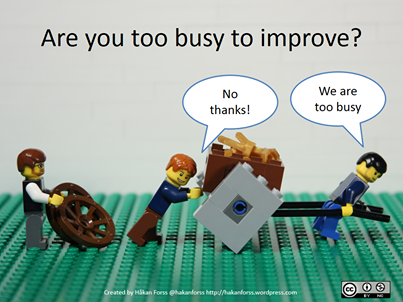
This also surfaces in the workplace in a different guise – too busy doing the job to determine if there is any better way – there was a great cartoon showing this – we should try never to fall into this trap.