It is always difficult to determine in advance what things that we say (or don’t say), what things we do (or don’t do) will have the most effect – and that is leaving aside the fact that a significant number of effects we will never be aware of at all. I have written a lot of things in notes, emails, letters and it is sometimes surprising how they come back later to surprise me!
I remember one time giving a paper at a conference which had a – very brief – section at the end which illustrated one of the many points I was making during the paper. It was, almost, a ‘throwaway’ to show practical applicability of a relatively theoretical paper. It was a real surprise when it came to question time that almost all of the questions were related to trying to get more detail about this throwaway example. (so much so that the following year I came back to the conference with a paper built entirely round that single point)
Equally surprising was the impact of a three page technical note I produced almost twenty years ago which was seen as a very important step forward in the research that we were doing then. The title of the note was “Time to Make a Decision” (which itself was a play on words as we were progressing through the research without necessarily making progress!) and the theme was that there are differing ways of dealing with decision making depending on how much time is available to make that decision.
Last week on LinkedIn there was a discussion started on “What times characterise human systems?”. It was said that
…it became clear sometimes there is little time for too much system thinking because the external system is moving too quickly
Now this I would disagree with – but perhaps only if we take the sentence literally – there is probably no instances of “too much” systems thinking – except in that sometimes there isn’t enough time to do enough and when you are out of time I guess you have done too much.
In the original paper I posited four time frames which were characterised by the way in which decisions were made. They were
- Instinctive
- Reactive
- Tactical
- Strategic
If I were to make a commentary on that today I would stress that these are not mutually exclusive and nor is it possible to draw a hard and fast line between them. Equally, I would stress that separating them into ‘four’ is not the only way to do it. It is, however, what I did at the time.
So, what characterises the time frames?
In the Instinctive mode everything is done and decisions are made automatically. There is no time to reflect on the process or consider options (although, of course, later you may wish to reflect on your chosen courses of action to see whether your instincts can be trusted). Decisions must be made immediately because although there are quick decisions that are right and quick decisions that are wrong – all slow decisions will be wrong. The decision maker will have pre-programmed responses to situations and must rely on his training/experience to have honed his instincts.
In the Reactive mode the decision maker does have some time available. However, the time pressures are still such that the number of options to be considered must be small and relevant to the context. Often there will exist a number of predefined series of actions to be carried out based on the decision made. Unlike the instinctive mode, reactive must continue to monitor the effects on the context that these actions are having because there may still be time to change the nature of the response.
In the Tactical mode the decision maker has sufficient time to make a considered evaluation of the options and to arrive at a more balanced judgement of how to maximise the effectiveness of the response.
The difference in the Strategic mode (to my mind) is that now the decision make has stopped ‘just’ responding and has the opportunity to try to control events.
Now, returning to the LinkedIn discussion, the only way there is “too much” systems thinking is when it cannot be done within the “time to make a decision”. I would certainly not go along with the idea that – even in the instinctive mode – there is no systems thinking. Unless you have a good grasp of the situation and the likely effects of your actions you will not be able to respond instinctively – so the systems thinking is embodied in your training and your experience – not necessarily in the moment of the decision making.
One of the underlying tenets of systems thinking is an understanding that you need to have a real grasp not only of “how the world is” but also “how the world will be after the intervention”. Whatever you do WILL change the world in some way and any action resulting from a decision will have to play out in the context of the changed world – not how the world is now. For this reason it is essential that systems thinking (although not too much!!) is embedded – regardless of how quickly the external system is moving – in fact because the external system is moving.
Of course, as we move away from instantaneous, instinctive responses and give ourselves more time and scope for the decision so we require more understanding of the changes in the ‘external system’. Why? Because the amount of uncertainty involved in visualising the world into which the intervention will be made will have hugely increased. This can be simply illustrated.
We all have a fascination for the weather and there is no doubt that weather forecasting has improved enormously as technology has become available to assist the forecaster. However, regardless of the sophistication of the technology, it is impossible to be 100% accurate with forecasts.
I look out of the window now and I can see that it is dry and cloudy – if I walk across to the canteen the Instinctive decision is to not bother with a jacket. However, the reactive decision has to be based on whether I believe that it will still be dry when I walk back! I CANNOT know that for certain, although based on what I can see and the likely time frame of the visit I can make an informed decision – albeit with some uncertainty.
At a tactical level, my decision may be whether to go now or in half an hour – will the weather be better/worse/the same in that time frame? Strategically – perhaps I plan my whole day around when the weather forecast is for drier conditions so that my coffee doesn’t get too soggy on the return journey!!
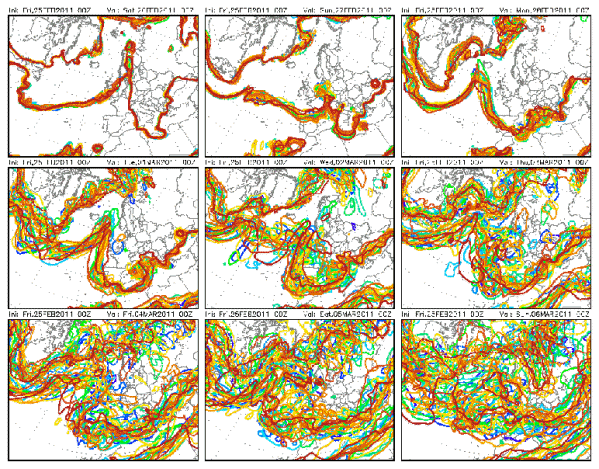
From this fairly typical nine day forecast we can see the problems facing weather forecasters. Each of the models have different strengths and weaknesses, different assumptions and constraints, different ways of ‘guessing’ what comes next as far as the weather is concerned. I use guessing rather than forecasting because as can be seen from the ‘spaghetti’ on the ninth day there is a huge amount of uncertainty,
(would you believe it – its now raining!!)
So it is likely that any intervention at the strategic level will have to take into account a level of uncertainty about the ‘state’ of the world when the intervention takes place that is considerably higher than is the case at the instinctive level, the reactive level or the tactical level. Perhaps that indicates that more systems thinking is required when you have more time – which fits neatly with the fact that you need more time to do the systems thinking.
Perhaps we have the time to do the right amount of systems thinking – regardless of how much time that is. Although I am sure that we will always feel that we should have done more.