This post is a sort of follow on to The Train Of Life (if anything) from some time ago. It was triggered yesterday by seeing a figure that seemingly was first tweeted back in 2021, but which was new to me.
The original tweet was by Tim Urban and this is the diagram he posted.
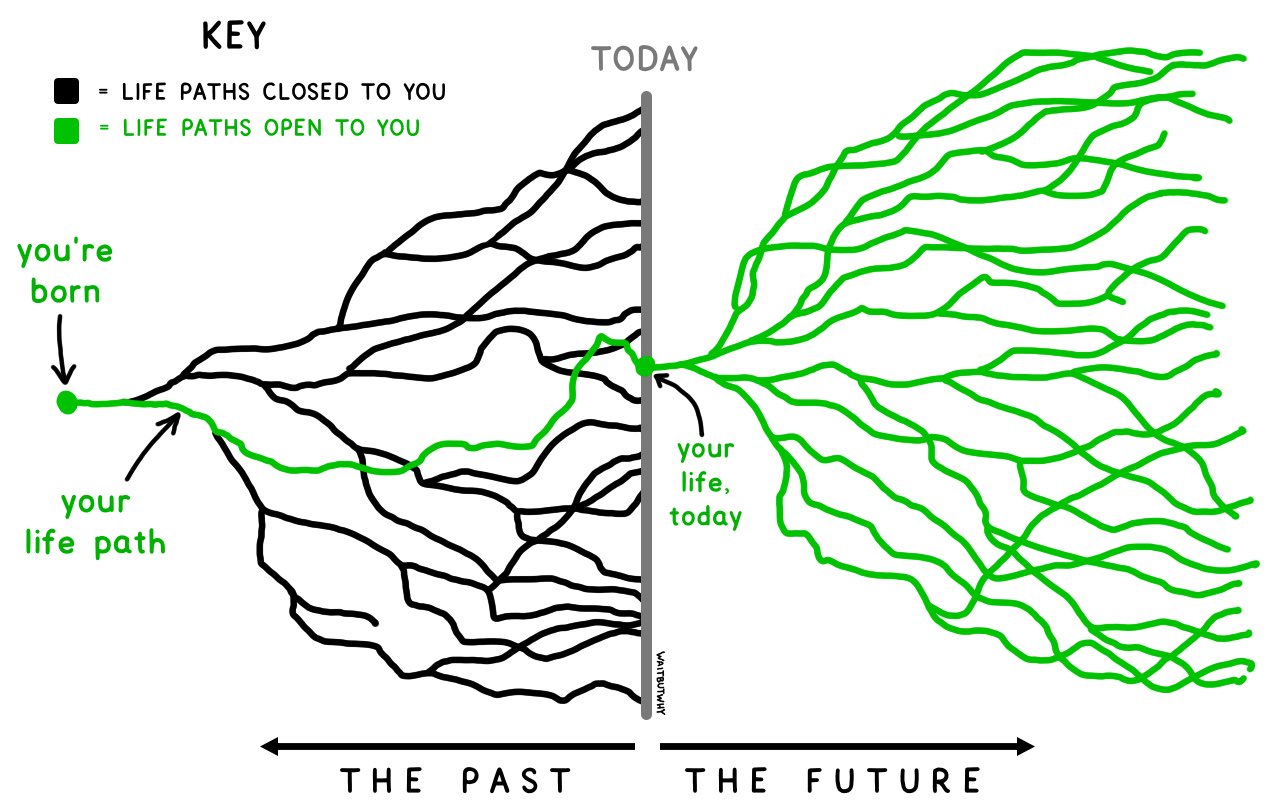
I have a few ‘issues’ with the diagram, but it is at the same time a useful illustration. To get to where you are now you have avoided – one way or another – many alternative routes each of which would have led you eventually to a different place now. Some of these are ‘close’ to the actual but most are quite a long way away from it.
In actuality, I think that my major ‘issue’ is that it is (perhaps necessarily) too simplistic – and because of that perhaps somewhat misleading. In fairness the original post had a quite specific purpose and I am here taking the diagram somewhat out of context. The point originally was that ‘people’ focus overmuch on the black paths that are no longer reachable and which were spurned or taken from them at some time in the past at the expense of not giving enough focus to the green paths which are, at this point, still in our control.
I empathise with that point of view – and have said similar elsewhere in this blog – yes, looking back gives us opportunities to learn, but that should only be in order to make better choices/decisions in the future when our path bifurcates.
Now, my describing the diagram as simplistic was not intended as a criticism – way back in my writing the idea of a ‘model’ was discussed a lot, although perhaps I have not used the term so frequently lately, and any model is a simplification of reality so that ‘parts’ of that reality can be understood. What is needed though is a clear statement of the simplifications and the possible effects on the uses of the model. This diagram is a model in that sense.
The first simplification is that the diagram is two dimensional – a VERY necessary simplification when using traditional ways of representation. That leads to an ‘unknown’ in viewing it – when lines cross do they actually ‘meet’ or do they simply pass by. From my worldview, I would probably argue that it is impossible to get to the same point by two different routes when considering the life journey. This is because of the fact that along the way you are gaining experiences, knowledge and behaviours that are unique to that path. So any ‘self’ you meet who has arrived there by a different path would be endowed with a different set of experiences, etc.. A multi-dimensional model would make the interpretation clearer.
A second simplification is that all of the ‘choices’ or ‘decisions’ are depicted as bifurcations – there is no example of having multiple options at a single point – which I think is often the case in real life. (although you can potentially reduce that to a series of bifurcations in some contexts).
I have become increasingly sceptical about the idea of coincidences – whilst there may be some situations where ‘real’ coincidences appear, my suspicion is that there is something more at work which leads to seemingly coincidental events – which are therefor far from coincidental. 🤣 I ended that with a laugh as even as I was writing it it was clear to me that I wasn’t being particularly clear about what I was saying.
Recently I was writing in my journal about the fact that for me – and I suspect for pretty much everyone – the way in which I met my life partner was along a path strewn by possible alternative endpoints – and the diagram here pretty much sums up a lot of what I was saying in terms of the left hand side – at least when viewed from the decisions that I had to make to reach the wedding day. Was it coincidental that this diagram appeared?
However – this example “my path to my wedding day” – is incomplete because there is another, similarly complicated, diagram that led to my wife being at that same point in time and space. She had also made many decisions along the way and only the actual set that she did make would have led her to my side.
Now we have come to the crux of my personal dissatisfaction with this model – good as it is in the simplistic case. Now we have two such models – overlaid on top of each other and all of these decisions – which took place in two separate (for the most part) life timelines – need to have taken the correct path through the maze.
It gets worse 😮 many of the decisions that led to the pair of us standing side by side at the altar were made by other people. This may seem strange to you if you haven’t considered this before – but as one clear example, if I hadn’t been seen as a “suitable candidate” for a job by someone working for Plessey in Liverpool I would not have ended up in the same geographic location as my future spouse. There are so many other examples of this.
As ever we now have a model that is growing exponentially more complex and it quickly stops being useful. I do think it is worth doing the though experiment though of trying to identify the least likely person who has contributed in a meaningful way to some aspect of where (and what) you are today. (and that meaningful way could be negative as well as positive of course)
There are, basically, two reasons why I shared this diagram here – the first is what I alluded to in the title and addressed briefly above. Once you make any decision and choose a path I believe that you can never return to the path (or paths) that you have rejected. Every step along the way adds to your experience, so even if you retrace your steps and choose the other path instead you have been changed by that diversion and do not return to the point of choice in the same state as when you first encountered it.
This is far from a new idea or outlook – Heraclitus, the Greek philosopher, once said,
This is, in essence, the same as what I am saying here in a rather less poetic way. I claim no originality in this thought. However, I suspect that – for many – the idea behind the quote is not something that they would recognise as part of their normal worldview.
This brings me to the second reason for the sharing of this diagram. I suspect that, for many, the complexity of life and decision making to navigate life is seen in a much more ‘blinkered’ way. I don’t use blinkered in a critical way, rather what is happening is necessary to blank out what might otherwise be overwhelming. We all need to tailor our worldview to what we personally can cope with and understand – our models cannot be too complex to comprehend. That means that – for everyone – some potentially significant information will be ignored or unknown. This diagram brings a relatively simple view that can help widen the focus to understand that things are never that straightforward.