If Only
I have had personal and harrowing experience of the "if only" thoughts - I find it hardest to deal with in respect of how my actions (or my inaction) affects other people. I don't mean directly - since that is 'usually' understood at the time - at least to a certain extent - I am talking about decisions that have long term repercussions that are far from what is envisaged.
...
We all make decisions - every day we make hundreds, some trivial, others more profound. We all make those decisions based on our knowledge and experience and 'hopefully' there are good reasons for the actions we take. (and by actions I include the option of "no action") Sometimes we will misjudge the situation and make the wrong choices - that is almost inevitable, and many is the time when we end up having to say "sorry, I made a mistake".
My real struggle with the "if only" involves situations where the decision is made, the choice is acted upon and the outcome exactly as expected - but...... and yes, you would expect there to be a "but".
In a game of chess, there are a limited number of legal moves that can be made at any time. The novice player will evaluate those moves and choose the best based on a particular set of criteria that he believes will result in a better chance of winning the game. The expert will do the same - however, the difference is that the expert has more experience, has more insight into how his opponent might react and - at least conceptually - he could rank all possible moves in terms of the likelihood of eventual victory. This is not practical due to the high numbers of options involved, but theoretically it could be done. Most people who are skilled at noughts and crosses can avoid being beaten - even if they cannot always win. Here the number of options are many orders of magnitude less than in the chess game.
Simplistically, life is just like that as well - however, instead of two players, there are millions and you can never be sure who is going to 'impact' on your game. Instead of a small number of valid/legal moves, there is almost an infinity of possible moves. Only a very small number are 'right' moves, so we can assume that most of the time we will probably get it wrong.
It is reasonable to assume that we (are able to) 'know' everything that has happened to result in "where we are" at a given moment in time and space - so, when we make a decision, we can (again theoretically, like in the chess analogy) with 100% accuracy characterise the situation. Like the chess analogy this breaks down when it comes to practically knowing as against theoretically knowing. However, for the purposes of this argument at present let us just follow through with the assumption that it is possible.
Lets also assume that the decision involves another person in some way. They can equally know how they got to where they are and can also make a perfectly correct decision. However, there is only partial overlap between the sum of knowledge of that other person and your own sum of knowledge. If you are 'close' then the overlap will be large. If you are complete strangers then the overlap will be negligible.
All decisions involve some aspect of "prediction" - of looking at that metaphorical crystal ball and plotting a course to a future point. That course will be determined by the sum of your current knowledge. If the other person involved is collaborating, then it is reasonable to assume that you can plot the course based on the sum of both parties present knowledge. However, if the other person is competing (and here that covers everything that isn't collaborating) then you are inevitably working off partial knowledge.
Many times, this is not a problem. We all get through life, for the most part, without this causing us much angst. However, from time to time things go awry. More so when you start to consider that the future point is going to be influenced by other factors that are currently outside of your "sum of knowledge".
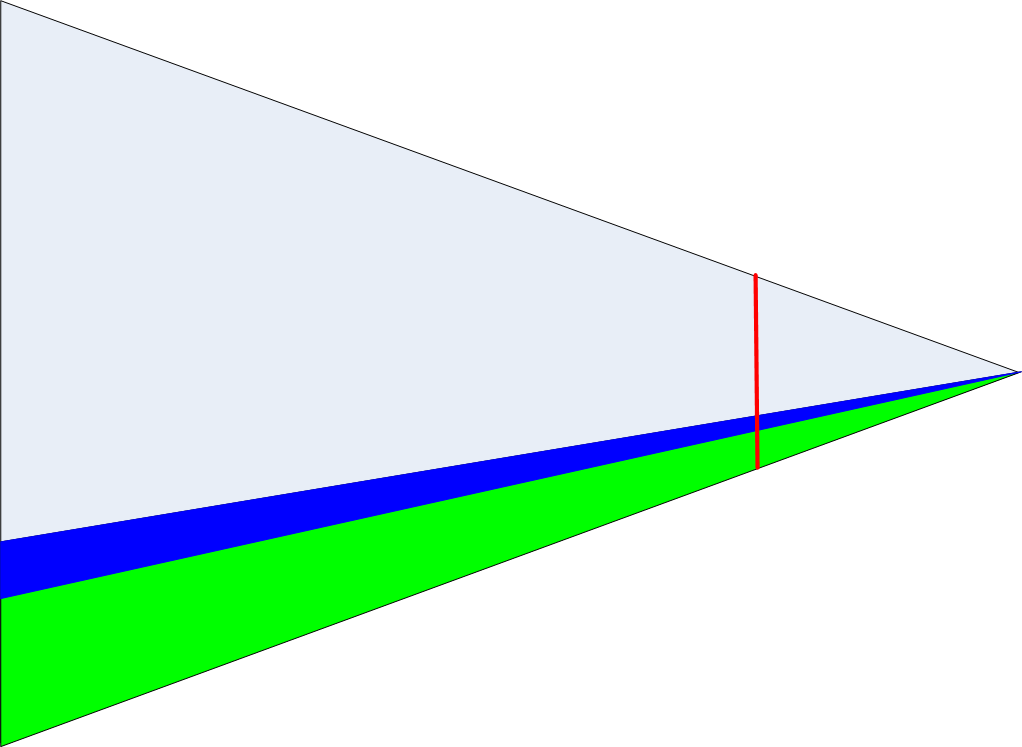
The triangle is an attempt to visualise the situation. The point at the far right hand of the triangle is representative of a desired future state. Everything within the triangle is something that in some way 'influences' that future state. So, for example, lets take a couple who have a child who is currently at school. The desired future state is for the child to graduate from university and become an architect.
As far as the couple are concerned their area of knowledge is represented by the blue and green triangles together. (note that the relative sizes are not meant to be exact depictions of the 'real' split between what is known and what is not)
The red line represents 'now' - everything to the left has already happened and is fixed - everything to the right is forecast. (In many respects this is easier to explain simply by taking the 'end point' as now - however, the diagram is a compromise - any two dimensional diagram is woefully inadequate to represent this particular thinking!)
Again - the things within the green and blue triangles to the right of the red line are things which are 'in the control of' the couple themselves. Things they know about. Things they can influence (more or less).
The much bigger portion of the triangle represents those things that are going to be a part of the end state that are not known to the couple, but which are critical to the achievement of the end state. The blue part of the triangle represents an overlap - things which are dependent on both the couple themselves and the 'rest of the world'. The green triangle are those things entrely under the control of the couple.
This is where the scaling is most wrong - the reality is that the green triangle will be VERY small. There is very little that is not influenced by 'outside' factors. If I had attempted to draw this "to scale" then the green triangle would have been more of less the bottom edge of the main triangle - little more than a line.
What this is trying to show is that the decisions made at the red line can only (at best) take into account the knowledge and experience that has resulted in getting there - EVEN IF we were able to recall all of that - and that is in itself an impossible task!!! The reality is that we 'remember' very little of "how we got to where we are" and a good proportion of that is pretty dubious. So, much of the green triangle may well be no more than fiction - especially in as much as it captures our reasons for doing things.
Going back to our couple - it is clear (to me at least) that there are many things both in the past and in the future that will influence the success of their achieving the goal. Not least the emotions, desires, life experiences of the child.
Each of us could sit down and (theoretically) look at all the things that had contributed to us being where we are now in our life - sitting at the apex of the triangle and considering what the green and blue triangles comprised. Even from that vantage point we cannot necessarily fill in the rest of the triangle - to take one set of examples - what about all the things that other people did not do that contributed to us getting to 'here'.
This, finally, gets me back to the "if only" - and allows me to explain the "but".
We make our decisions, we act on them, the outcome is "as expected" - but there are the usual unintended consequences. All those things we didn't think of, including many we couldn't think of. Why? Because we can only see the "coloured triangle" that leads to where we are now, we cannot see more than a tiny fraction of the rest of the triangle that will lead to the future state.
This is true of things that we do and it is true of things that we do not do. Crucially (in terms of the "if only") even looking back from where we are now, we cannot see the triangle that would have resulted if our decision had been different. The only thing we can be sure about is that we wouldn't now be looking at the world through the same experiences as we are doing. Things most certainly would have been different. We know not how.
An example, I could sit here and say "if only I had known then, what I know now" (the precise subject doesn't actually matter) - I would surely have made better decisions. I know how life has turned out. I know which decisions were good ones and which were not so good. One quite specific thing 'missing' from life is the fact that I didn't ever learn to swim.
Now - through my life I think that there hasn't been that often that I would have benefitted from swimming. However, part of the reason for that may well be that I couldn't, so I was making decisions based on the fact that I couldn't swim. There have been times when I considered the "if only" question in relation to that - including when my own children were learning to swim - it would have been so much more 'comfortable' knowing that I could do something about it if they got into difficulties. Instead I had to adopt other defenses - perhaps keeping them in safer territory as a result.
From that you could imagine that if I were a competent swimmer (as a result of satisfying my "if only" desire) then I may well have unwittingly put my own children in greater danger by being less "risk averse" than I actually am. These things I don't know - but they show that satisfying that "if only", whilst it brings a possible benefit, also brings possible risks.
The same is true for all the "if only"s - they ALL, without exception, carry the risk of the unknown. We can - for certain - close down the precise results of the 'so-called' wrong choice - but we do not know what possible damage we are doing to all the other threads through life. This is - of course - most true about the major decisions that we have made - simply because they are the most far reaching.
Without going back and trying the "if only" - and then living the rest of our lives to see what the ultimate outcome is - we cannot find out whether we made the right choice and - none of us gets that opportunity. I know that choices I made nearly forty years ago have an impact now - sometimes having lain seemingly dormant for long periods.
The "Only if" corollary is that only if I had lived my life exactly the way I have done would I have reached the point in space and time that I am at - nothing else would have done. Any change to my past would put me at a different point NOW. That point could be better - could be worse - I think that most people, if they are open and honest about it, would admit that the upside is small - the downside is huge. Is that a risk that I would be willing to take?
We each have our worries, our problems, our cares, but it could be so much worse. Yes, of course we will be more seduced by the "if only" when we are at our lowest - however, that is perhaps not the best time to consider it.
It is, for me at least, much more difficult when our "if only" involves a decision that resulted in hurt for someone else. The important decisions here are not necessarily when the action itself involved hurt (since presumably that would have been factored into the equation, since - unfortunately - hurt is sometimes unavoidable), but when the consequences - the unforeseen consequences - resulted in hurt somewhere down the line. Where a decision sets someone off on a different life course that involves pain, sadness or other difficulty. Where a decision results in circumstances that are far from pleasant - especially when the decision was made on partial knowledge that 'could' have been completed.
However, even in these circumstances, I honestly do not think that I would risk changing the decision if I was given another chance. Is there some limit - is there some line that I would not cross - is there something that I would choose to change even if it risked something worse? Don't know - but I guess it obviously depends on how do you judge "what is worse"? The ultimate blocker is that often the resulting pain, sadness, whatever is unavoidable - changing the choice that was made does not, in itself, make any difference.
Categories: Philosophical, Systems Thinking, Decision Making, Worldview, ----------